07 May, 2010

The Shrine-room


Lately, I’ve been thinking of the symbolism and spiritual significance of a shrine. Often, when I’m reading a book, the word will surface, highlighting a different association or meaning of the word, thereby sparking off new brain-waves! :)

We are all too familiar with shrines, being in a deeply spiritual land. Personally, I think of a shrine as a physical as well as a mental space, where your inner-self retreats to, where you can still the muddy waters of your heart-mind. Physically, this space can be a meditation hall/room or even a cell, similarly a prayer hall/room. I also see the shrines in which we place an image or a sculpture of our personal/family deity as symbolic of the shrine within us. As if the shrine outside has a corresponding or parallel space within - a space where our higher-self resides.

Coming to the title of this post, I knew the shrine-room was the working-title for my current works after I exprienced an "aha!" moment, while reading it in venerable monk Sangharakshita’s book, Living with Kindness. :)

Love + light!
Happy Weekend :D
P.S: To Old Vipassana Meditators- Guruji S.N.Goenka will impart metta and discourse at Global Vipassana Pagoda, Gorai as part of a one-day dhamma seminar on May 27th, call and register in advance, get their number from the Pagoda's website.
Be Happy! :)

01 May, 2010

Spring, Igatpuri: 2 day self-course.

Last weekend I attended a two day self-course for old vipassana students at Dhammagiri, the Vipassana Meditation centre in Igatpuri. It is hard to believe that two days of turning your attention within can bring about so much peace and change in one's life. I feel better, renewed and I couldn't have gone at a better time, even though temperatures have been hovering around 35 degrees celsisus. There were beautiful flowering trees and the birds twittered and babbled from dawn till dusk :)

Igatpuri was where it all began for me, and it is a pleasure to return each time. As I grow older, I now appreciate more things, for example like being able to meditate in a peaceful environment where the meditation hall is kept ready for you much before you have entered, where the paths are swept of fallen leaves each day, where your meals are lovingly served, and teachers watch and listen patiently to everyone, over 200 women in each course and as many number of men too.

It was delightful to be in the midst of nature, walking past well kept flower-beds from the meditaion hall to one's room. You open your door and you are outside :) Sorely miss that in a flat.

Its funny how as you get older you look forward to hours of meditation and then listening to the discourses at the end of the day. The mind due to its conditioning isn't very helpful but expereience tells you otherwise and you know how much you will learn and enjoy the spoken wisdom after you have put in your practise for the day :) (theory and practise should go hand in hand- Goenkaji's words).
Here are a few photos I took of place before and after the course. Hope you enjoy :)


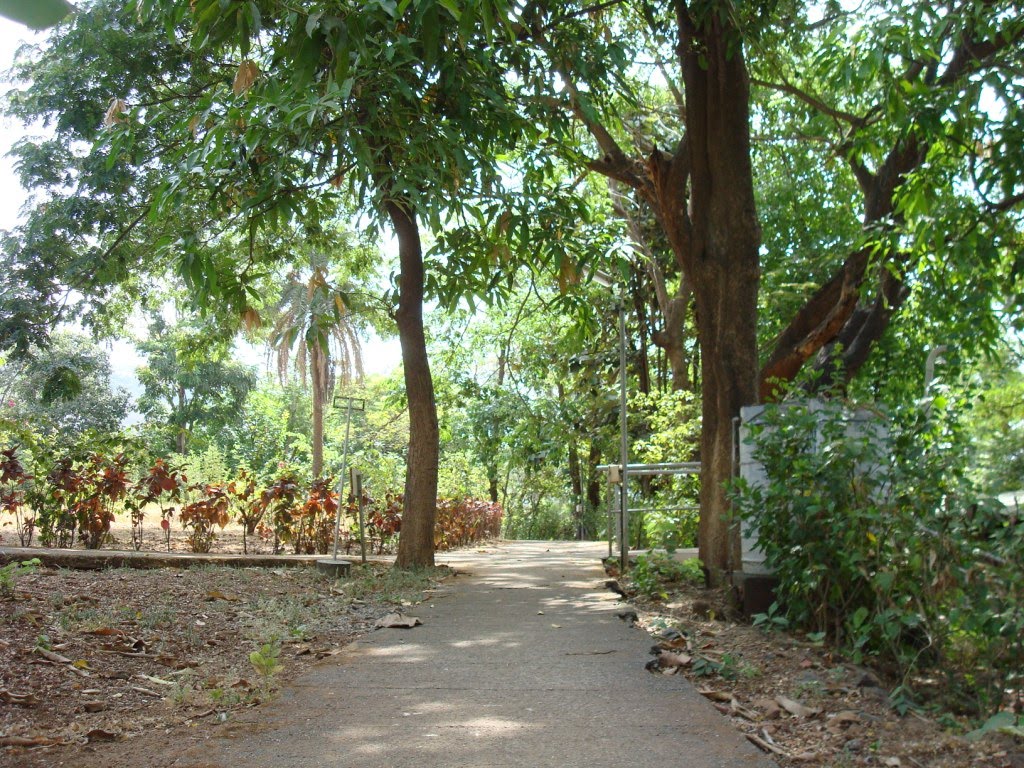
Walking area for women.


Imposing mountain facing Igatpuri Vipassana Centre


View of the mountains as one walks out of the meditaion centre.


Near the main gate is the recently erected replica of the Ashoka stambha.


As you enter you pass through the elegant Myanmar gate, which reminds one of the story of how the teaching of Vipassana was lost to India but was preserved in Burma, from where it returned to India after 2,500 years and then spread to the world.

love + light!
Have a lovely weekend!

22 April, 2010

Nature therapy- Aarey guest House

Aarey Guest house is my favourite part of Aarey Milk Colony, your cellphone will not receive any network here, so the moment you enter to the moment you leave, you are alone.....with nature and give or take a few more people :)
Spring, summer has such an intoxicating effect, I think I love all seasons, even hot and humid April... there are many trees in brilliant bloom right now..... many parts of the world will be witnessing the earth returning to life with buds and young leaves reassuring us of nature's eternal cycle of impermanence.

Here are a few pictures I took during my last walk at Aarey Guest House, enjoy! :)


The path leading up to the guest houses situated on top of a hill, when you reach the top you get a beautiful view of the city. I took these pictures in the evening.


Didn't get a very good shot, but you may notice pods bursting with cotton.....red silk cotton tress? will find out...


African wattle tree with its yellow blossoms strewn on the path, I love these blossoms, this is my "Indian Spring" :) they are the flowers that inspired me to take pictures in Aarey, if you walk in the New Zealand Hostel area, you will find entire canopies of these trees in bloom, and the delicate blossoms raining on all and sundry....


Gravel and flower in what is called the "golden hour", the last light of the sun which has a magical effect.....


my favourite picture, in the background is a defocused image of a lady, resident of the forest no doubt, collecting wood for domestic purposes......
and here is a link to a beautiful website that will give you information on the Flowers of India.


Have a lovely weekend!
Love + light!

19 April, 2010

Jacob Hashimoto


Slip into vapour, Jacob hashimoto, 2005,

The other day I was going through a fabulous book, Sculpture Today, and I came across Jacob Hashimoto's delicate yet durable art-works which exist between sculpture and painting. What I like best about his work is how a traditional technique such as kite-making with rice paper and bamboo frames translates into striking installations made up of myriad tiny parts which appear to float or cascade.

Here is more on his work from Artnet.
(b.1973) Jacob Hashimoto cuts rice paper into small geometric shapes and glues the shapes to delicate wooden frameworks, which he attaches to black fishing line and ties to long wooden pegs at the top and bottom of his rectangular, wall-mounted, waterfall-like hangings. The pegs are evenly spaced from side to side across the top and bottom of the piece.

The artist ties six roughly overlapping layers of shapes onto each peg, creating a dense, kaleidoscopic multi-level field in which a given shape may be visible or hidden, depending on the angle of view. The hanging seems to move as we walk past....

Slip into Vapor could almost be a landscape. Measuring five feet high and four feet wide by 7.5 inches deep, it is composed of paper ovals, each roughly four inches wide, which are mounted on X-shaped frameworks and suspended between 13 wooden pegs at the top and 13 below. White and blue ovals, suggesting clouds and sky, comprise the upper half of Slip into Vapor, while darker ovals in the lower half could be rocks, soil or vegetation. The artist collages long slices of green paper-like grass onto some ovals and puts fanciful decorative designs on others. As the viewer walks by, these peep out to surprise and amuse.

Hashimoto begins by making wooden frames from tiny sticks, tying them together with thread, and affixing translucent rice paper to them. If he wants color or a design, he collages it onto the paper shape -- nothing is painted. When a framed shape is ready, he dips it in acrylic resin for strength. After creating a large inventory of these elements, he selects shapes of different size and design, and strings them on nylon line, which he employs because it does not stretch. Now he is ready to tie the strings to the pegs.

Followers